

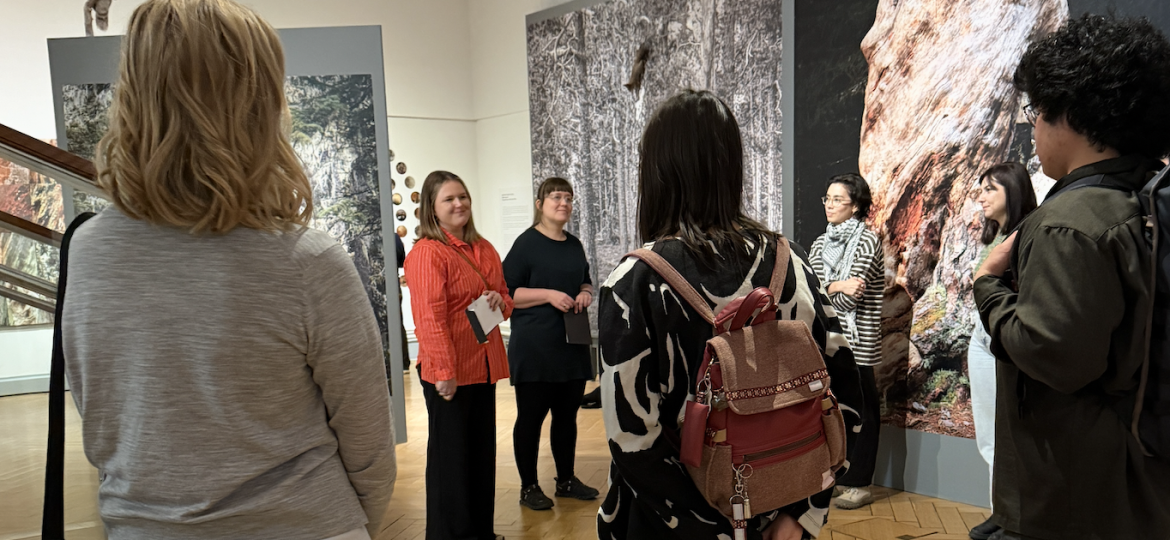
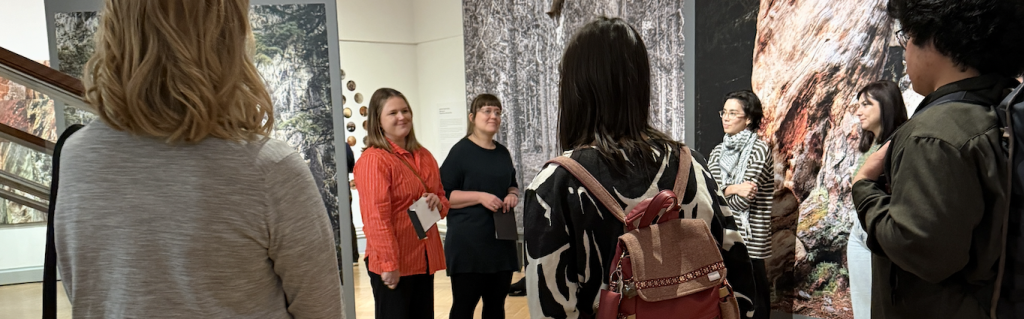
Whose voice is heard in futures discussions and decisions? Whose voice is almost silent? To explore these questions, we (Anni Leppänen, Marttiina Arelma, and I) organised Voice of Forest workshop on Futures Day 2026.
This long read explains the thinking behind Voice of Forest, walks through our methodology of multispecies and experiential futures approaches, and shares the inspiring prototypes created by the participants.
Why forests?
Because the forest’s voice, as a multispecies ecosystem, is missing from the very discussions where it belongs.
In the current forest discourse, public debate, and policymaking, we tend to view forests through human-centered lens. We see forests as economic assets, carbon sinks, recreational spaces, or raw-material sources. Even biodiversity and nature conservation related discussion often treats nature as capital that must keep producing benefits for us, humans. What is missing is the forest’s own perspective. What does the forest, as a multispecies ecosystem, need in order to flourish? To be able to understand the question, we have to challenge the idea of human exceptionalism and realism that our well-being and ecosystems are inextricably linked to the survival and flourishing of other forms of life. In practice, we should start seeing forests as webs of relationships, long-memory systems with their own needs, rhythms, and timescales. This is why Voice of Forest workshop wasn’t at all about what forests provide for us. It was about honoring their right to exist and thrive as living systems we coexist with.
Why experiential futures?
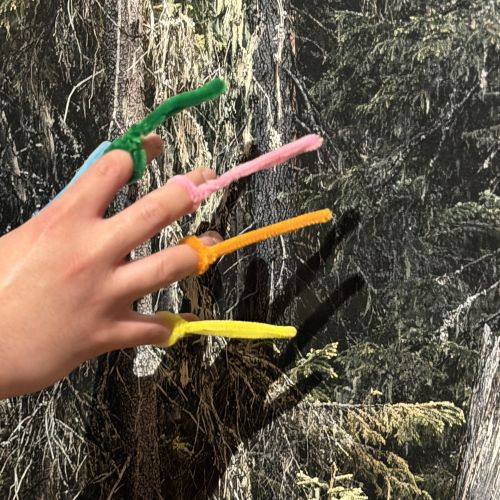
Traditional foresight processes often remain abstract, expert-driven, and disconnected from people’s everyday experiences. As a result, they may struggle to generate emotional engagement, a sense of agency, or meaningful participation in shaping future trajectories. In the Voice of Forest workshop, we explored alternative approaches by inviting participants to engage with forests through multiple sensory and creative modalities, including listening, touching, smelling, discussion, imagination, drawing, and hands-on artefact creation.
This approach builds on what futures scholars Stuart Candy and Jake Dunagan describe as the “experiential gulf”: the gap between abstract knowledge about possible futures and people’s lived experience of those futures. In addition their research suggests that such experiences can expand imagination, challenge existing assumptions, and strengthen people’s capacity to act in support of preferred futures. (Read more: The Experiential Turn (Candy & Dunagan, 2017).
Why multispecies?
We wanted to shift perspective and see possible futures through the eyes of forests, asking how their voices could be better represented in decision-making. Design and policy work tend to stay human-centered, overlooking the interdependency between species that’s key to any sustainability transition. Multispecies is more-than-human approach emphasises systemic thinking and empathy. Some governments acknowledge the concept of multispecies justice, which means an ethical and legal framework proposing that non-human entities (such as animals, forests, and river systems) have interdependent needs and should be explicitly considered in political and environmental decision-making. New Zealand’s Whanganui River and Te Urewera forest, Colombia’s Atrato River, and India’s Ganges and Yamuna rivers are among the most cited examples.
However, there are limits in this approach. Humans inevitably interpret what a forest might “need” and speak on its behalf, making projection difficult to avoid. Yet this does not diminish the value of the exercise. Attempting to imagine a forest’s perspective encourages humility, reveals assumptions that often go unquestioned, and fosters forms of empathy and systems thinking that can influence how people understand and act upon sustainability challenges. Rather than speaking for nature with certainty, multispecies thinking helps us become more attentive and responsible participants in the living systems upon which we depend.
1. Exhibition as inspiration
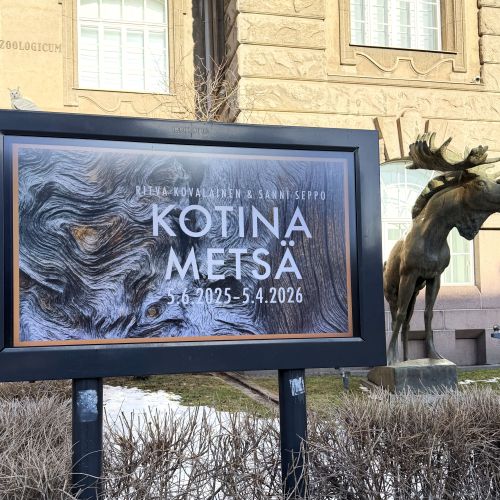
After a short welcome, participants explored the Forest Home exhibition by photographers Ritva Kovalainen and Sanni Seppo.
They were guided by three questions:
- What kind of forests are represented here?
- What is a forest made of?
- What is your own relationship with forests?
2. Opening circle
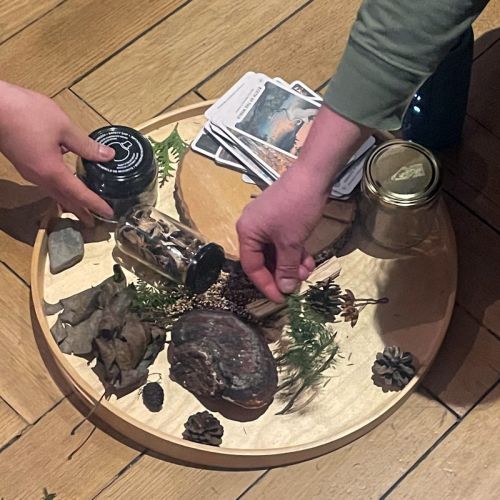
We brought forest elements (pine branches, leaves, a jar of soil, pine cones, stones, pine scent, birds sing, a polypore, dried mushroom, wood slices, and a Nordic Forest Rituals card deck) and invited each participant to choose one object that called to them.
In the circle, everyone introduced themselves and their object, along with a wordless sound and movement expressing “the forest in you.” We then paired up to discuss how our relationships with forests have changed over time.
3. Forest Scenarios by Kone Foundation
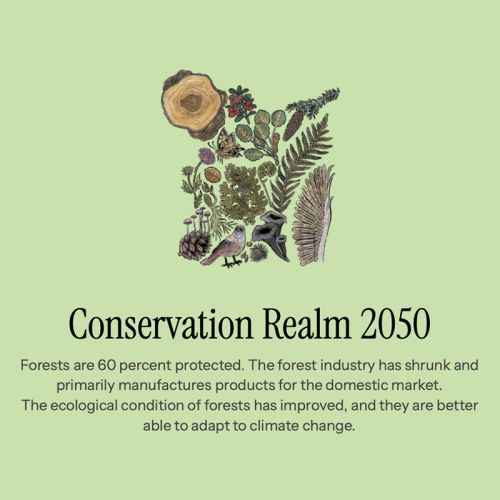
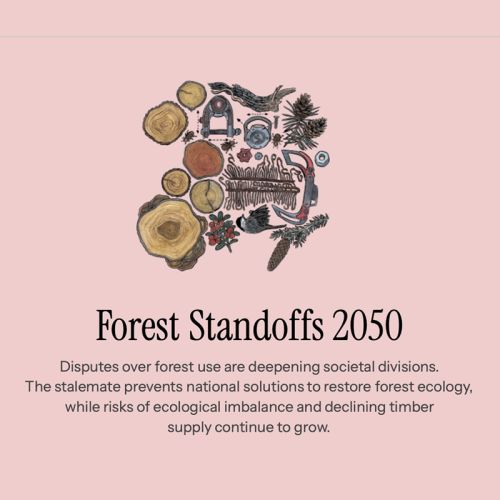
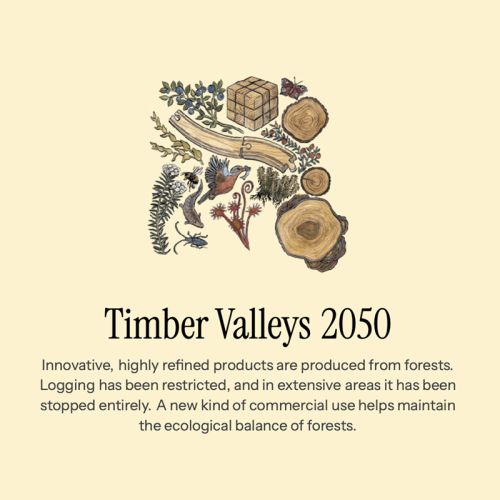
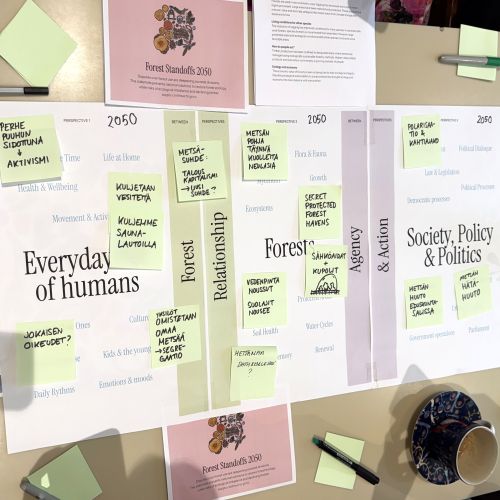
In 2025, Kone Foundation and DialogiAkatemia produced four forest futures scenarios. We selected tree of them as the foundation for our own scenario exercise in which participants chose a scenario to read before the next exercise.
- Forest Standoffs 2050. Forest conflicts worsen ecology and timber supply.
- Timber Valleys 2050. Limited logging, innovative products, balanced forests.
- Conservation Realm 2050. Most forests protected, healthier and climate-resilient.
4. Imagination exercise: mental time travel
Participants closed their eyes as our facilitator read a guided meditation, accompanied by futures and forest sounds, helping them imagine the future described in their chosen scenario. We adapted this technique from colleagues Savannah Vize and Andrea Gilly, building on methods pioneered by Rob Hopkins, Phoebe Tickell, and Jane McGonigal. Our script also shares common ground with Symboiesis’s Collective Imagination Practices Toolkit.
5. Scenario development
Groups formed around each scenario and used a custom canvas to develop it further, starting by sharing what they’d imagined during the meditation. The canvas was designed to surface the boundaries between daily human life, forests, and society’s political and policy processes — centred on one question: how is the voice of the forest represented in this future?
6. Prototyping
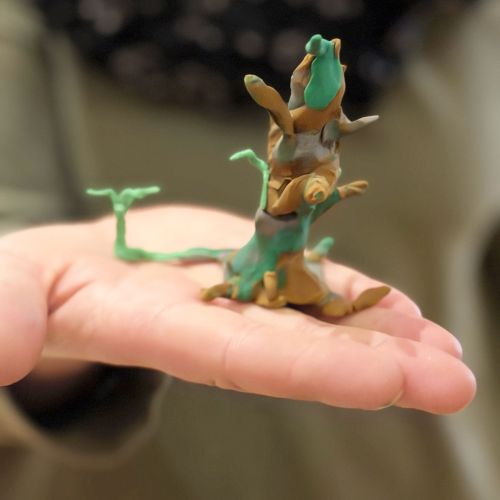
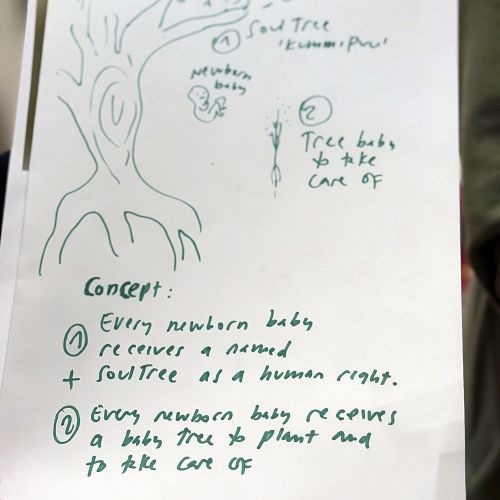
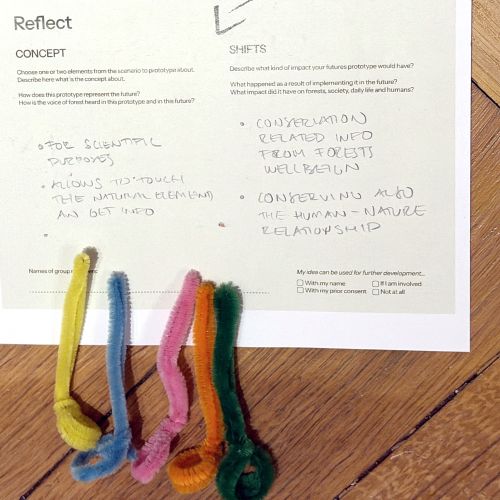
We paired participants to built tangible futures prototypes using a card deck of prototyping modes and a template for describing their concept and its impact.
Prototyping modes: artefact (an object from the future), apace (a blueprint for a futures room), Roleplay (a simulation or facilitation guide) · Story (written fiction) · Movement (embodying a future ritual) · Audio/video (a recording from the future)
Concept: Which elements of the scenario are you prototyping? How does this represent the future — and how is the forest’s voice heard in it?
Shifts: What impact would this prototype have? What changed for forests, society, daily life, and people?
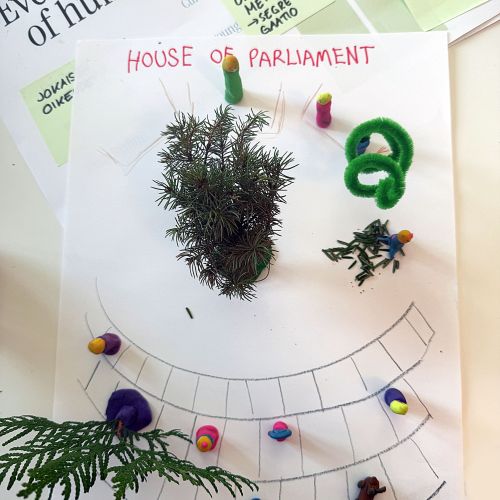
This workshop showed how differently the future looks when imagined through the eyes of the forest. Participants described feeling more connected, more grounded, and more aware of forests as living systems of relationships — not just resources.
We’re clear-eyed about the limits: this was still an exercise run by humans. We didn’t bring forests into the room, and we can’t fully speak on their behalf. Even so, opening space for more-than-human perspectives to shape how we imagine the future proved genuinely insightful.
The takeaway is simple, but powerful: when we widen the circle of who gets to shape the future, entirely new possibilities come into view.